


The earliest evidence of tobacco use is far older than most people think. Recent archaeological discoveries in North America suggest humans were using tobacco as far back as 12,300 years ago—during the Ice Age. From charred tobacco seeds found in Utah to nicotine residue detected in an ancient smoking pipe in Alabama, these findings are reshaping what we know about prehistoric tobacco use.
Because once someone starts talking about “the earliest tobacco use,” they are not adding a small detail to the story. They are moving the whole beginning.
For a long time, the cleaner version of the timeline felt simple enough: tobacco belonged to the Americas, Indigenous peoples used it long before Europeans arrived, and the archaeologically visible part of that relationship sat mostly within the last few thousand years, increasingly tied to cultivation, pipes, ritual use, and later the colonial force that carried tobacco across the world.
A neat timeline. Familiar. Easy to live with.
Then archaeology did what it usually does to neat timelines.
It broke them open.
Two discoveries matter here more than most people realize.
One comes from Wishbone, in what is now Utah’s Great Salt Lake Desert, where archaeologists found four tiny charred tobacco seeds in an ancient hearth dated to about 12,300 years ago.
The other comes from the Flint River site in northern Alabama, where researchers chemically identified nicotine in a carved stone smoking tube dated to 1685–1530 BC.
Put those two finds side by side, and the story starts to look much older than the usual version allows.
What did Utah actually find?
The Wishbone site sounds almost modest until you understand what was sitting in the ash.
Researchers excavating an ancient hearth in Utah’s West Desert found a campsite linked to hunter-gatherers near the end of the Pleistocene. Around that hearth were the expected traces of life: tools, waterfowl bones, signs of fire, the practical debris of survival.
And inside that same context were four charred seeds of wild tobacco.
The burnt material from the hearth dated to roughly 12,300 years ago, pushing the evidence for human tobacco use back by around 9,000 years beyond what had previously been documented
.
What makes that date important is not just its age, but where it places tobacco in the human story.
At 12,300 years ago, we are not talking about farmers managing a crop. We are not even talking about settled village life in that region.
We are talking about foragers near the end of the Ice Age.
So the relationship begins not with agriculture, but with recognition.
Someone, somewhere, had already figured out that this plant was worth bringing close to the fire.
It is also worth pausing on a small but important detail: seeds are not why anyone would use tobacco. Their presence suggests that larger parts of the mature plant were brought to the hearth along with them — leaves, stems, or seed-bearing capsules — and that the plant was being handled, processed, dried, or consumed in some way. One plausible explanation is that leaves and stems were being chewed or sucked, leaving the seeds behind as discarded byproduct. What the seeds make hard to defend is the idea that this was random botanical debris.
And the hearth itself was not some empty patch of ash. It was a real campsite. Archaeologists found more than 2,000 bone fragments there, along with stone artifacts, charred willow wood, and the remains of a wetland landscape that looked nothing like the dry terrain we know today. Back then, the area was marshland, rich in birds and wetland plants, and many of the bones belonged to ducks and other waterfowl.
That context makes the tobacco harder to dismiss as stray plant debris. The seeds were found in a human hearth, and researchers argued the tobacco was probably brought in from plants growing in nearby foothills or mountains rather than from vegetation accidentally burned on the spot.
This is also the point where the story needs discipline.
Wishbone is not the oldest certain proof of smoking.It is the oldest known evidence of human tobacco use.
The seeds do not tell us, by themselves, whether the plant was smoked, chewed, sucked, or handled in some other way. What they do show is that tobacco was present in a human hearth context at a shockingly early date.
That alone changes the conversation.
One more detail is worth stating plainly: the seeds themselves were not directly radiocarbon dated. The age comes from burnt material in the same hearth context. That does not weaken the discovery, but it does mean the claim should be kept precise.Because these were not a few seeds drifting through random dirt.
They were sitting inside the remains of human activity.
So, this does not look accidental. It looks deliberate.
In 2021, Daron Duke and colleagues reported charred Nicotiana seeds from the Wishbone site in Utah, pushing direct evidence for human tobacco use back to roughly 12,300 years ago. See: Duke et al., “Earliest evidence for human use of tobacco in the Pleistocene Americas,” Nature Human Behaviour 6, 183–192 (2022).
Four tiny seeds, and a much older beginning
This is the part I like most.
Because the Wishbone find does not show us tobacco as commodity, status symbol, plantation crop, or rolled luxury object.
It shows us something much earlier, and honestly more fascinating: a human experimenting with a psychoactive plant in a world where nearly everything useful still had to be discovered the hard way.
Before tobacco became economics, it was chemistry.Before it became cigar, cigarette, or empire, it was alkaloid.That is why Wishbone matters.
It drags tobacco out of the late historical frame and places it back inside one of the oldest human habits of all: trying plants, and remembering which ones changed something inside you.
But if Wishbone gives us the earliest chapter, it still leaves one major question open.
When do we move from association to direct evidence of smoking technology?
That is where Alabama enters the story.
Flint River: when the evidence gets harder
At the Flint River site in northern Alabama, archaeologists studied a carved stone artifact known as FS74, described as a smoking tube or “medicine tube.”
This was not a vague stain in the soil. Not a seed near a hearth.
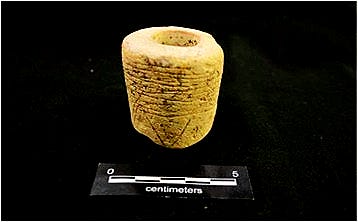
It was an object made for use , a shaped object, a cultural object. And when researchers extracted and analyzed residues from it, they identified nicotine.
That is the point where the argument becomes much harder to wave away.
The date is what turns the find from interesting into disruptive.
The tube’s age was established through radiocarbon dating of associated material, placing the relevant context at 1685–1530 BC.
That pushed direct evidence of tobacco in southeastern North America back by more than a millennium beyond earlier residue-based finds.
In other words, tobacco was not simply entering an already mature smoking culture at a late stage. It appears to have been there much earlier than the old model allowed.
The object itself helps too. The tube was carved from stone and engraved with concentric circles and chevrons.
I love that detail because it rescues the artifact from abstraction.
This was not just “sample FS74.”
It was a crafted thing shaped by human hands, made with intention, and used in a way that left behind a molecular trace strong enough to survive for thousands of years.
So was it only tobacco in that pipe?
Not necessarily.
The Flint River research also pointed toward other compounds that may reflect a more complex plant mixture.
That does not mean every ancient smoker was preparing some elegant prehistoric blend. But it does suggest that ancient smoking practices may have involved more than one plant and more than one purpose.
And that matters because it pulls us out of a modern trap.
We tend to imagine tobacco use as recreational first, because modern commercial tobacco trained us to see it that way.
But many Indigenous traditions across the Americas treated tobacco as sacred, ceremonial, medicinal, diplomatic, or some combination of the above.
So when nicotine appears in a carved smoking tube from the second millennium BC, the most serious reading is not “prehistoric habit.”
It is early, structured human engagement with a powerful plant inside a cultural system we still only partly understand.
The wider picture is getting harder to ignore
If Wishbone stood alone, it could still be dismissed as an odd and unusually early find.
If Flint River stood alone, it could be treated as a dramatic regional surprise.
But neither stands alone anymore.
Other biomolecular studies in North America have also identified nicotine in ancient pipes from Indigenous contexts, reinforcing the larger point: the archaeological story of tobacco has been getting older, deeper, and harder to confine inside the old timeline.
And once that older timeline starts giving way, a different picture appears.
The human story of tobacco in the Americas no longer begins with agriculture. It begins earlier, in foraging worlds.
Then later, by the Late Archaic, we can already see tobacco inside specialized smoking technology.
That arc is the real revelation here: from plant encounter, to repeated use, to formalized smoking practice long before the later agricultural and commercial phases most people know first.
That is a better story anyway, and a truer one.
Because it reminds us that tobacco did not become important the day Europeans noticed it.
By then, it was already ancient.
Verdict
So what do Wishbone and Flint River actually prove?
They do not prove that Ice Age people were definitely sitting around smoking in the modern sense.
Wishbone is older than that claim, and subtler than that claim.
What it gives us is the oldest currently known evidence that humans in the Americas were already using and deliberately handling tobacco around 12,300 years ago.
Flint River then gives us something narrower, but harder: direct chemical evidence of nicotine in a carved smoking tube dated to 1685–1530 BC in southeastern North America.
Taken together, that is enough to redraw the opening map.
Not the map of cigars.
The map underneath them.
References
Duke et al., Earliest evidence for human use of tobacco in the Pleistocene Americas, Nature Human Behaviour, 2021.
Carmody et al., Evidence of tobacco from a Late Archaic smoking tube recovered from the Flint River site in southeastern North America, Journal of Archaeological Science: Reports, 2018.
Tushingham et al., Biomolecular archaeology reveals ancient origins of indigenous tobacco smoking in North American Plateau, PNAS, 2018.
Natural History Museum of Utah, People Used Tobacco in Utah 12,300 Years Ago.