


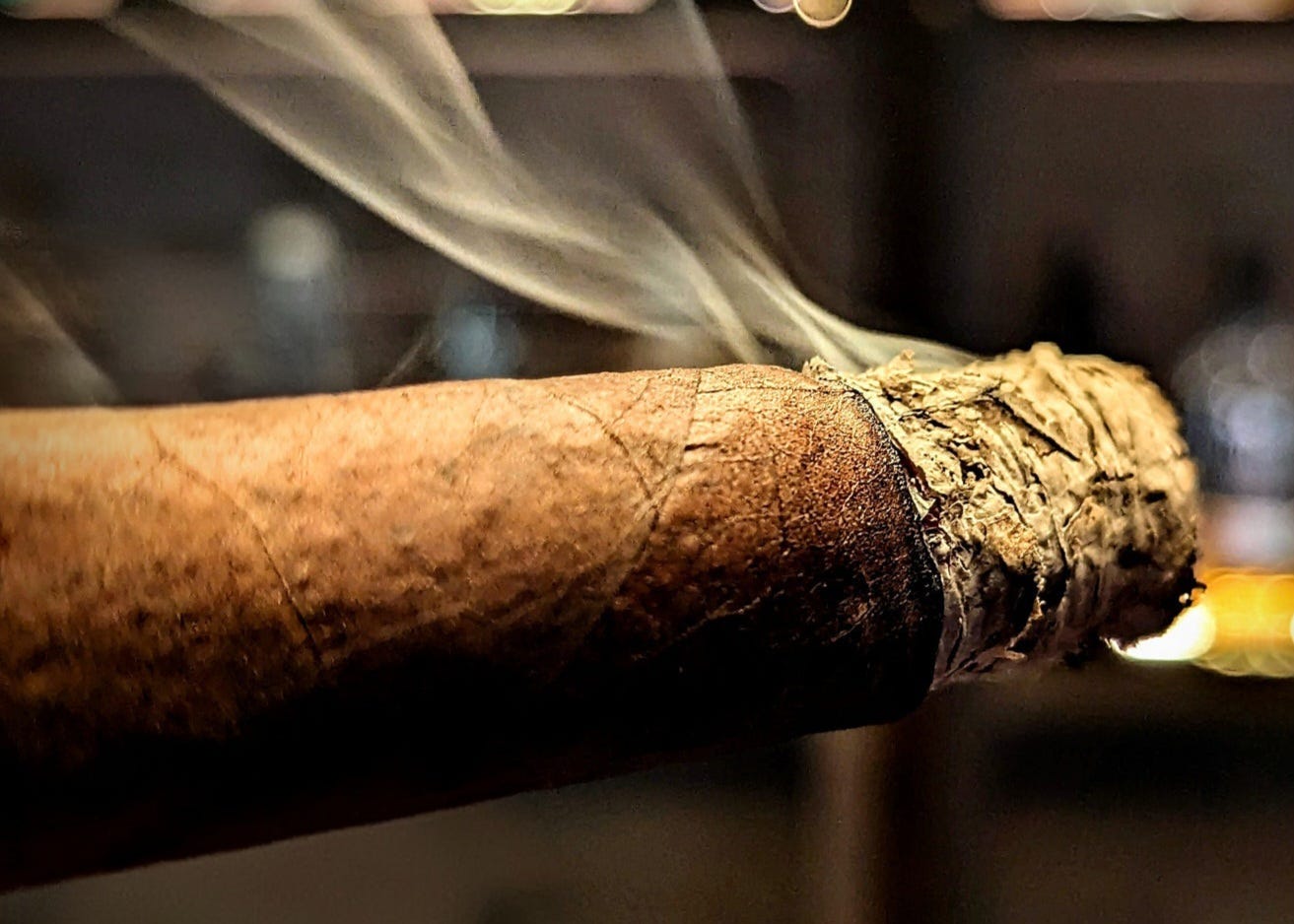
Most smokers have the wrong idea about how cigar flavor develops.
They often talk as if every cigar has a fixed flavor profile hidden inside the leaf, and smoking it simply reveals that profile step by step. First cedar. Then bread. Then cocoa. Then pepper. All supposedly arranged by the blend and the familiar three thirds.
But that is not really what is happening.
Blending is part of the story, of course. It matters. But it is not the whole story.
A lit cigar is not a box of flavors waiting to be opened. It is a constantly changing smoke generator. What the smoker experiences is not the leaf as it sat in storage, or even the leaf as it existed a moment before. It is smoke created under changing heat and physical conditions, then changed again as it travels through the cigar, into the mouth, through the nose, and into the nervous system.
That difference matters far more than cigar culture usually admits.
The first essay in this series looked at what cigar notes can be made of. The second dealt with the confusion that happens when aroma, irritation, texture, and taste all get thrown into one loose category called flavor. This essay asks a different question.
What actually happens between the burn line and the smoker? Why does a cigar keep changing during the session?
The simplest answer is this: the smoker does not receive leaf. The smoker receives smoke, and smoke is already transformed matter.
What the smoker receives is smoke, not leaf
By the time it reaches the smoker, tobacco has become a moving aerosol made up of gases and particles. It is no longer a quiet agricultural ingredient waiting to be translated into tasting notes.
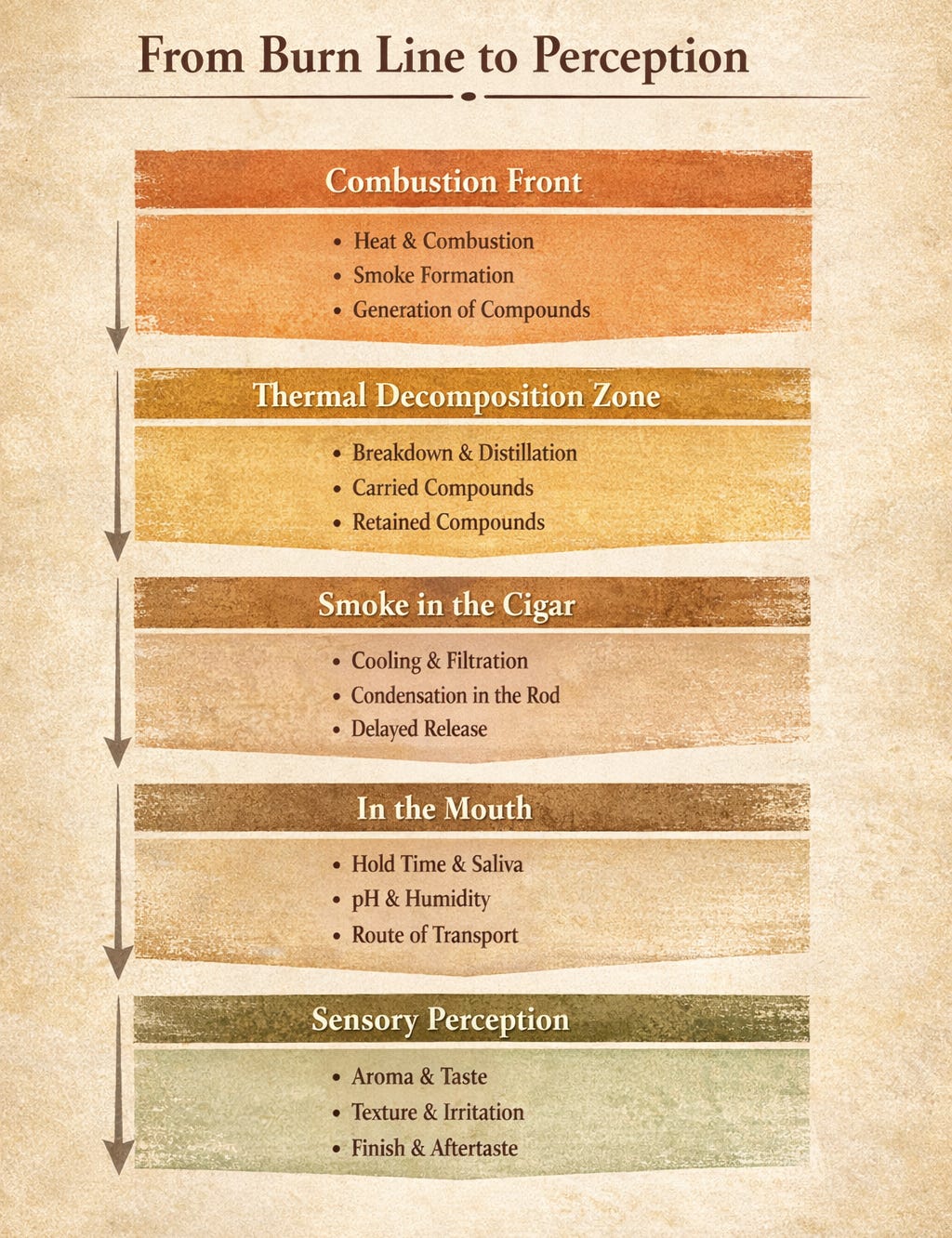
Smoke formation in burning tobacco is not one simple event at the cherry. It involves overlapping combustion, thermal breakdown, degradation, and distillation-like transfer. After that come cooling, condensation, absorption, filtration, and dilution as the smoke moves through the cigar.
That alone should change how cigar flavor is written about.
Most tasting language still suggests that the smoker is “tasting the tobacco,” as if fire simply reveals what was already there. In reality, the smoker is reading a moving system.
Heat creates compounds. Other compounds are changed, cracked apart, carried forward, cooled, trapped, released, or lost. The sensory object is not just an unlit cigar plus fire. It is the smoke stream produced by all of those processes happening together.
That is a more accurate way to think about a cigar. It is also a more interesting one.
The burn line is not the whole story
The burn line is not the whole story
It is not enough to stare at the glowing coal and assume that all the important action happens there.
The burn line matters, obviously. But it is only part of the process. The active combustion front, the nearby thermal breakdown zone, and the movement of smoke through the remaining body of the cigar all help determine what finally reaches the smoker.
Some compounds are created during the puff itself. Others form while the cigar smolders between puffs, remain trapped inside the cigar, and are pulled forward on the next draw.
In other words, not all the smoke you receive is freshly created in that moment. Some of it may have been produced earlier, held inside the cigar, and delivered later.
That is worth thinking about.
It means a cigar is not just one hot point followed by passive transport. It is a chain of formation, retention, release, and transformation.
It also means the common habit of describing a cigar as if it gives off one clean, unified profile from foot to head is far too simple for the physics involved.
One stream becomes several sensory routes
Then the smoke reaches perception, and the simplification becomes even worse.
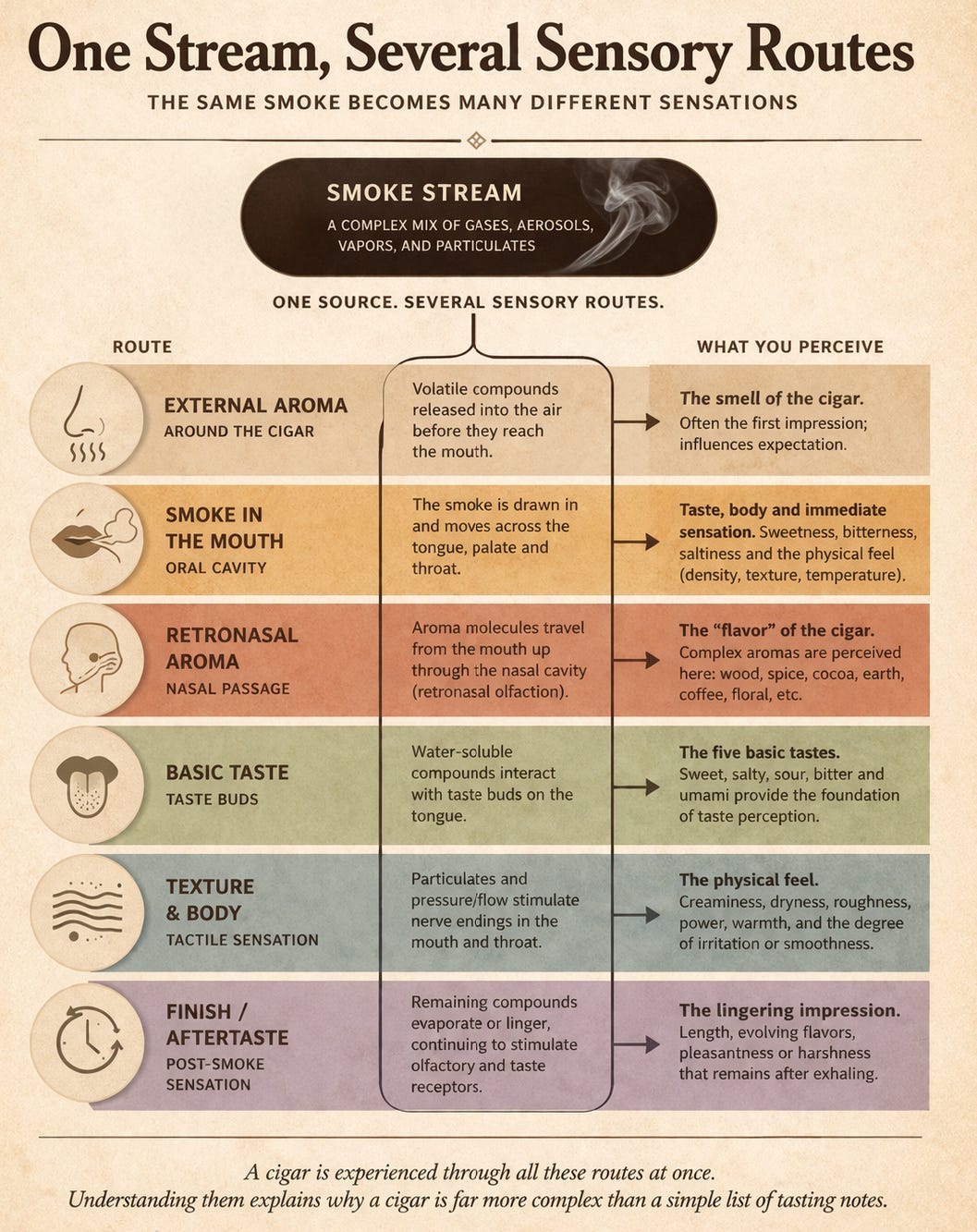
One physical stream does not become one sensation. It becomes several.
There is the primary aroma from the burning wrapper. Then there is the aroma produced by the combustion of the whole blend: wrapper, binder, and filler. There is the secondary aroma between puffs, which includes primary aroma along with burned molecules from earlier puffs that were retained inside the cigar. That can create more complex impressions.
There is the room smell during smoking. There is smoke in the mouth. There are retronasal notes released during exhalation. There are basic tastes the smoke can trigger. There is the fullness left in the mouth. There is dryness, pressure, sting, heat, and irritation. There is also the finish and aftertaste that remain after the visible smoke is gone.
This is one reason cigar language can sound vivid while still saying very little.
One stream enters perception through several routes, and the brain rebuilds it as a single experience. Smells taken in from the outside world and smells reaching the olfactory region from the back of the mouth do not follow the same path. They do not behave as if they are identical.
Put simply, much of what a smoker thinks he is “tasting” in a cigar is actually aroma arriving from inside the act of smoking itself. And what people call “Cigar Flavor Wheels” are, in most cases, really aroma wheels, often without much grounding in proper sensory science. But that belongs in another article.
This should make serious tasters more careful about how they review and describe cigar flavor.
The smoker helps shape the stream
There is another complication, the smoker is not passively receiving the stream. He is helping create it.
Puff size, puff duration, puff interval, and draw intensity are not small details. They are part of the mechanism. Cadence changes what is generated, what is retained, what is released, and what finally reaches the smoker.
The smoker is not only reading the stream. He is partly producing the version of the stream he later tries to describe.
Smoke a cigar slowly, and certain features may stay clear for longer. Push it too hard, and the sensory picture can thicken, blur, and harden. Bigger puffs do not always mean more information. Sometimes they do the opposite.
Sometimes a smoker calls that increased complexity because the experience feels stronger, heavier, and more forceful on the palate. But what may have actually happened is that the stream became less readable.
The mouth is not a neutral tunnel
The mouth also plays a larger role than most tasting language suggests. It is tempting to think of the mouth as a neutral passage between cigar and nose. It is not.
The mouth is warm, wet, active, and constantly modifying what passes through it. Hold time matters. Saliva matters. pH matters. Hydration matters. Previous meals matter. Digestion matters. Humidity matters. The route of exhalation matters. Even before the retrohale enters the picture, transport has already become part of perception.
The lazy model, a compound exists, therefore a note is perceived is not enough, as delivery matters too.
This matters because cigar tasting is usually described as if the cigar does all the work and the smoker simply reports the result. That is not true.
The smoker’s mouth is not just where the smoke passes. It is part of how smoke becomes experience.
Why the cigar changes as it burns
This gives us a better way to think about progression.
Cigars do change. The old language of thirds has survived because smokers are not inventing progression out of nowhere. But the usual explanation is often too simple.
A cigar does not change merely because some magical section of the blend has suddenly “opened up.”
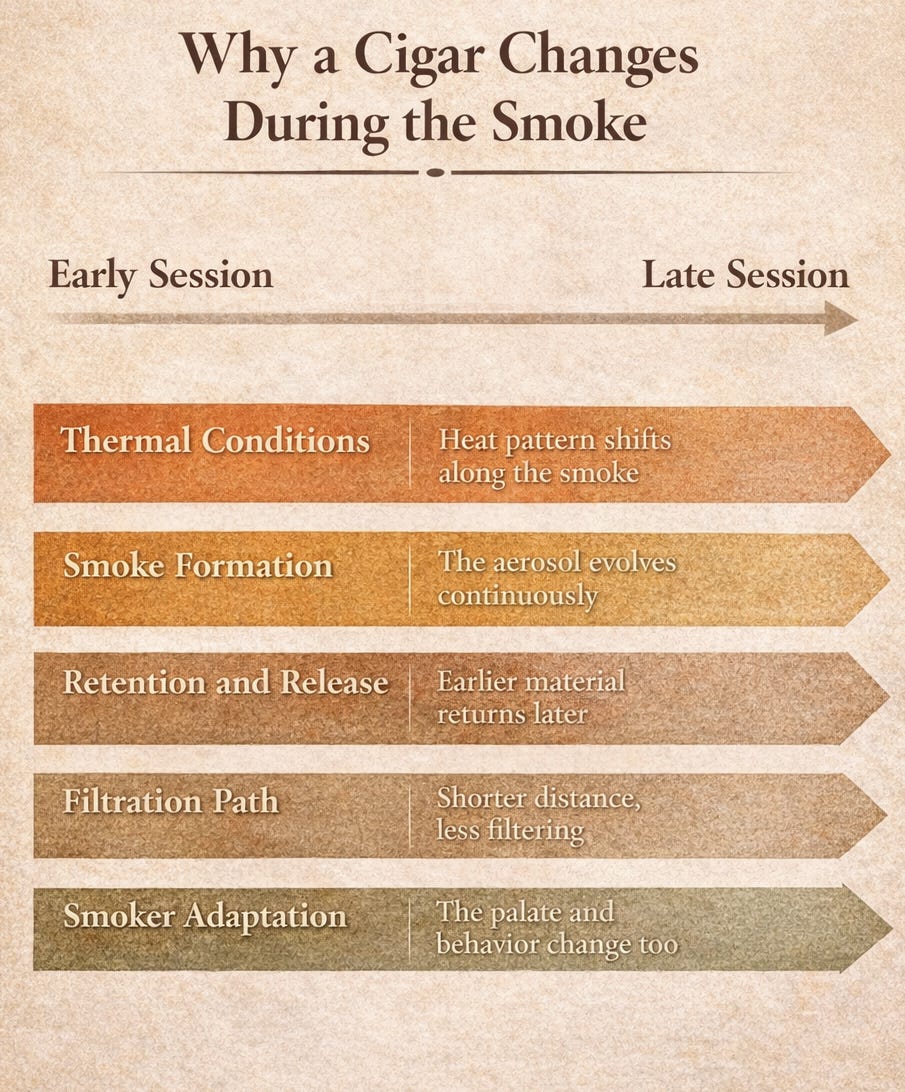
Progression is better understood as the combined result of changing thermal conditions, evolving smoke formation, retention and later release of compounds inside the cigar, a shortening filtration path, shifting puff behavior, and sensory adaptation in the smoker over time.
That last part matters more than it may seem.
Perception does not stay fresh forever. Repeated exposure changes what the nervous system notices. A cigar that seems darker or stronger in the second half may truly be delivering a heavier stream. But it may also be meeting a drier mouth, an adapting nose, and a smoker whose behavior has become less disciplined or less focused than it was at the beginning.
Progression is real. But it is rarely as simple as “another part of the blend opened up,” which is how commercial reviewers often explain it.
Louder is not clearer
This is where cigar culture keeps making one of its most persistent mistakes: confusing strength with clarity.
A cigar that gets louder is not necessarily becoming more expressive. Much of the bite, sting, scratch, and heat that smokers fold into the language of flavor belongs to a different part of the experience than aromatic identity.
Those sensations are real. They matter. They shape the smoke. But they are not doing the same job as aroma.
A cigar can become more aggressive while becoming less legible.
That is one reason so many tasting notes disappear in the second half of a cigar. It is not always because the smoker suddenly runs out of vocabulary. Often, the stream itself becomes harder to read, and the loud parts of the experience begin crowding out the informative ones.
A cigar can be felt more while saying less.
That distinction is not small. It is one of the most important things a serious smoker can learn.
What this changes in tasting language
Once you see the cigar this way, a lot of familiar cigar language starts to look crude.
A tasting note that simply lists cedar, cocoa, pepper, earth, and cream as if they are all the same kind of thing is flattening a much more complicated reality.
A better note would not only name impressions. It would separate them.
What appeared in the aroma? What became clear retronasally? What changed in texture? When did irritation begin rising faster than aromatic detail? What lingered after the puff was gone? What changed because the cigar changed, and what changed because the smoker changed?
That is how sensory science works across fields, from food to coffee to wine to cigars.
A cigar does not move from leaf to language in one clean step. It becomes smoke. The smoke changes in transit. The smoker reshapes the stream through behavior. Perception then rebuilds that stream through multiple channels over time.
Until cigar writing reflects that sequence, much of what passes for tasting precision will remain polished shorthand for a much messier physical reality.
And that is where the next essay has to begin.
Because once you accept that a cigar is not one simple flavor stream, the practical question becomes impossible to avoid:
How should a smoker handle that stream in order to read it more clearly?