


You read a cigar review and the guy says cherry, dark chocolate, roasted nuts, cedar, cream, maybe even a faint fermented tang on the retrohale.
And your first reaction is fair.
What exactly is this man smoking?
Because a cigar is just tobacco. Fermented leaves. No cherries. No cocoa. No bakery tucked inside the filler.But that is exactly why the question is worth asking.
Those tasting notes are not automatically nonsense. They are not just proof that cigar smokers enjoy hearing themselves talk. In many cases, they are the human translation of something real. Tobacco is chemically dense to begin with, and once you air-cure it, ferment it, age it, and then light it, you are no longer dealing with a simple leaf. You are dealing with a moving cloud of aroma compounds, oils, acids, degradation products, and heat-built molecules that overlap with the same sensory families we already know from fruit, toasted bread, roasted coffee, flowers, wood smoke, earth, and fermented foods.
That does not mean every reviewer is right.
It does mean the whole thing is not a myth.
Tobacco is not one thing
One of the easiest ways to make this subject stupid is to throw all tobacco into one bucket.
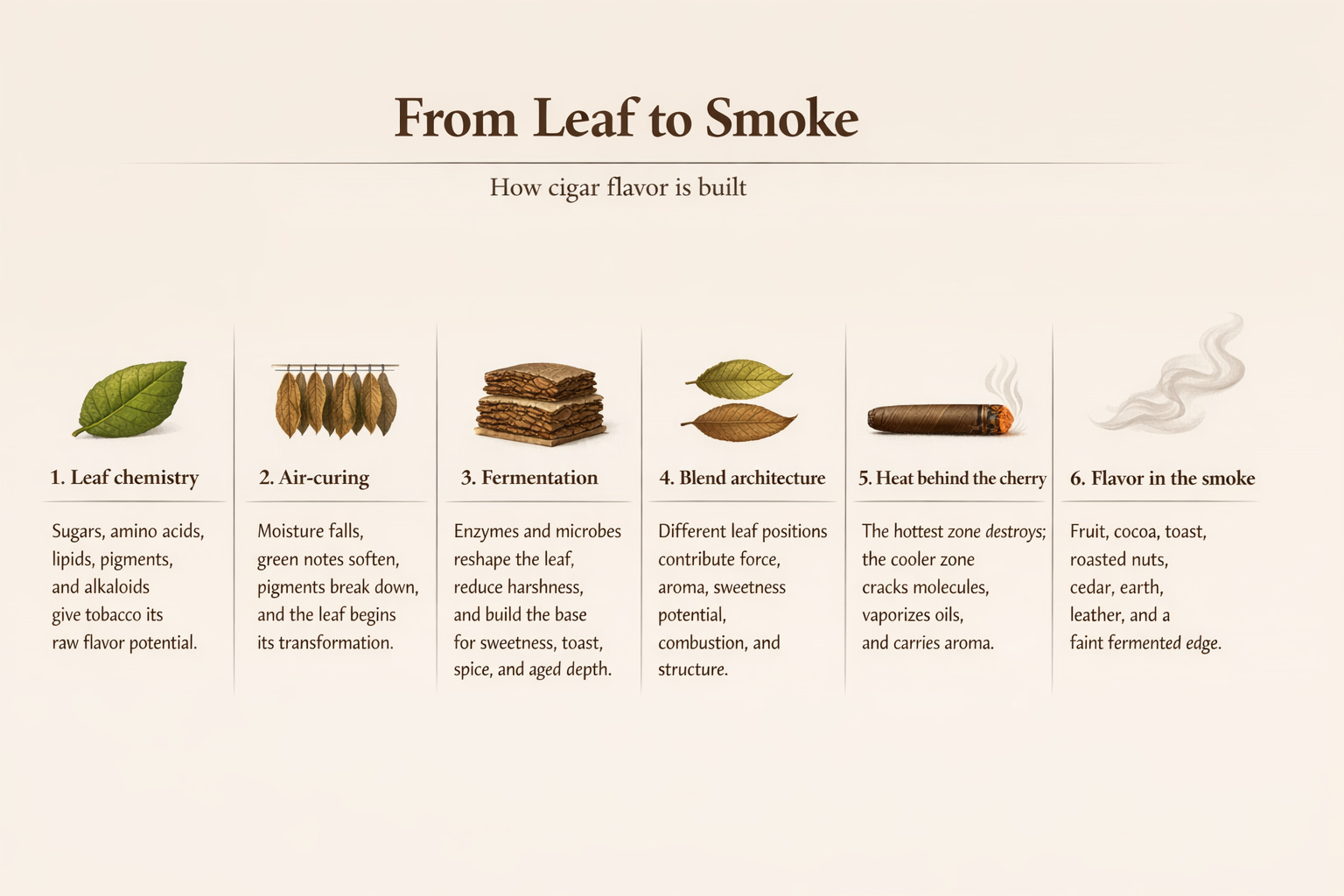
Premium cigar tobacco is not built like cigarette tobacco. The route matters. Cigars rely on air-curing and fermentation, and that changes the chemistry in a serious way. The leaf is not simply dried and stored. It is transformed. Harshness drops. Raw green notes soften. Some compounds disappear. Others form. Some precursors survive and wait for heat to finish the job later.
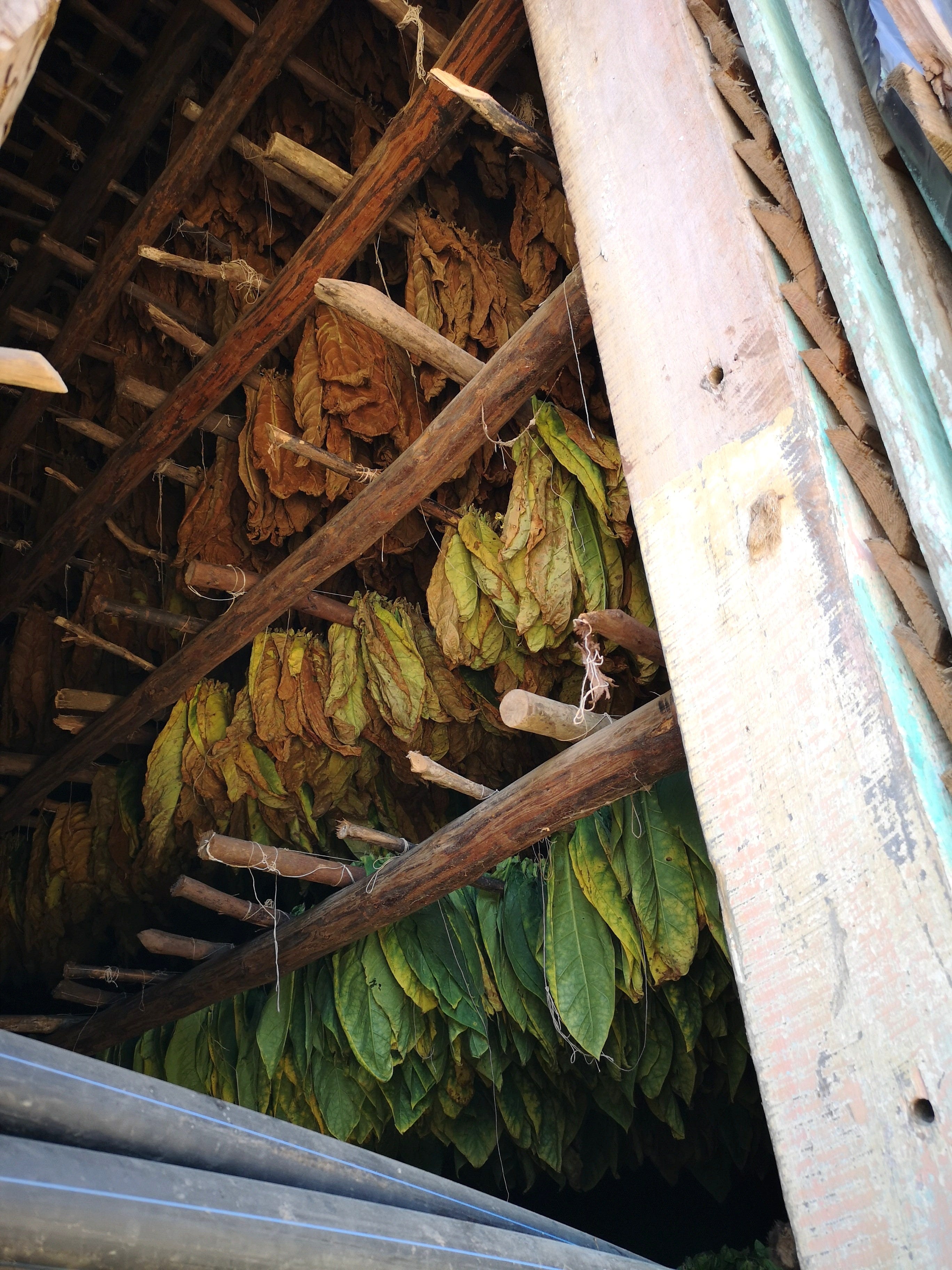
Older studies on other tobacco types are still useful because they prove one important point: tobacco is chemically crowded. A classic analysis of flue-cured tobacco essence identified 323 compounds. Another analysis of flue-cured tobacco essential oil identified 306 compounds. On the cigar side, a more recent study identified 235 volatile compounds in cigar smoke, including heterocyclic compounds, ketones, phenols, alcohols, aldehydes, esters, alkenes, and aromatic hydrocarbons.
That does not mean premium cigars are chemically identical to flue-cured tobacco. They are not. But it does make one thing very hard to deny:
tobacco is not simple, and cigar smoke is not simple either.
A cigar is not one chemistry. It is several.
There is another mistake people make: treating a cigar as if it were one uniform brown cylinder.
It is not.
A cigar is not one chemistry. It is several chemistries rolled together.
Even before the cigar is lit, the blender is already working with different personalities from different parts of the plant. Broadly speaking, the upper leaves tend to carry more alkaloids and more nitrogen. Middle leaves usually bring more balance and more sweetness potential. Lower leaves help in other ways, especially with burn, flow, and structure.
In cigar terms, you already know these roles instinctively, even if you never say them in chemistry language. Some leaves bring force. Some bring aroma. Some help the cigar breathe and burn correctly.
That matters because a cigar is not made from one flat flavor source. It is built from leaves that behave differently under fermentation and differently again under heat. That is one reason a cigar progresses the way it does. The blend is not chemically uniform, and fire keeps rewriting it as you smoke.
Where the flavor actually begins?
Start with carbohydrates.
Tobacco carries sugars and larger carbohydrate structures, and those do much more than feed the plant. During curing, fermentation, aging, and smoking, they break down, rearrange, or survive long enough to become part of later reactions. This is one of the main roads toward toast, caramel, warm grain, crust, and roasted sweetness.
Then come proteins and amino acids.
This is where fermentation becomes actual work. Bacteria and enzymes begin breaking things down. Proteins, amino acids, sugars, pigments, lipids, all of them start moving. That breakdown is part of why properly fermented tobacco stops smelling raw and starts smelling deeper, rounder, darker, and more composed.
Then there is chlorophyll and pigment breakdown, which sounds dry until you realize how much of the softer side of cigar flavor lives here. Hay. Dried sweetness. Floral lift. Tea-like softness. Faint fruitiness. That polished, almost quiet elegance some cigars carry without ever becoming sugary.
And then there are the darker smoke compounds — the ones that pull the profile toward wood, leather, char, toast, incense, and darker spice.
So when someone says a cigar tastes oak or cedar wood, the right response is not blind belief and not blind mockery either.
The right response is: which part of the chemistry are we probably dealing with?
The studies do support the basic idea
This is the part too many articles skip.
The chemistry behind cigar flavor is not built on one vague claim that “fermentation improves taste.” It is much more specific than that.
Researchers tracing aroma formation in tobacco keep landing on the same broad roads: carotenoid degradation, chlorophyll breakdown, Maillard chemistry, amino-acid metabolism, lipid metabolism, and the formation of volatile compounds during curing, fermentation, and combustion.
One recent cigar-smoke study traced flavor formation back to five major precursor families: cembrenoid compounds, phenylalanine, chlorophyll, carotenoids, and reducing sugars.
That matters because it gives the article its backbone.
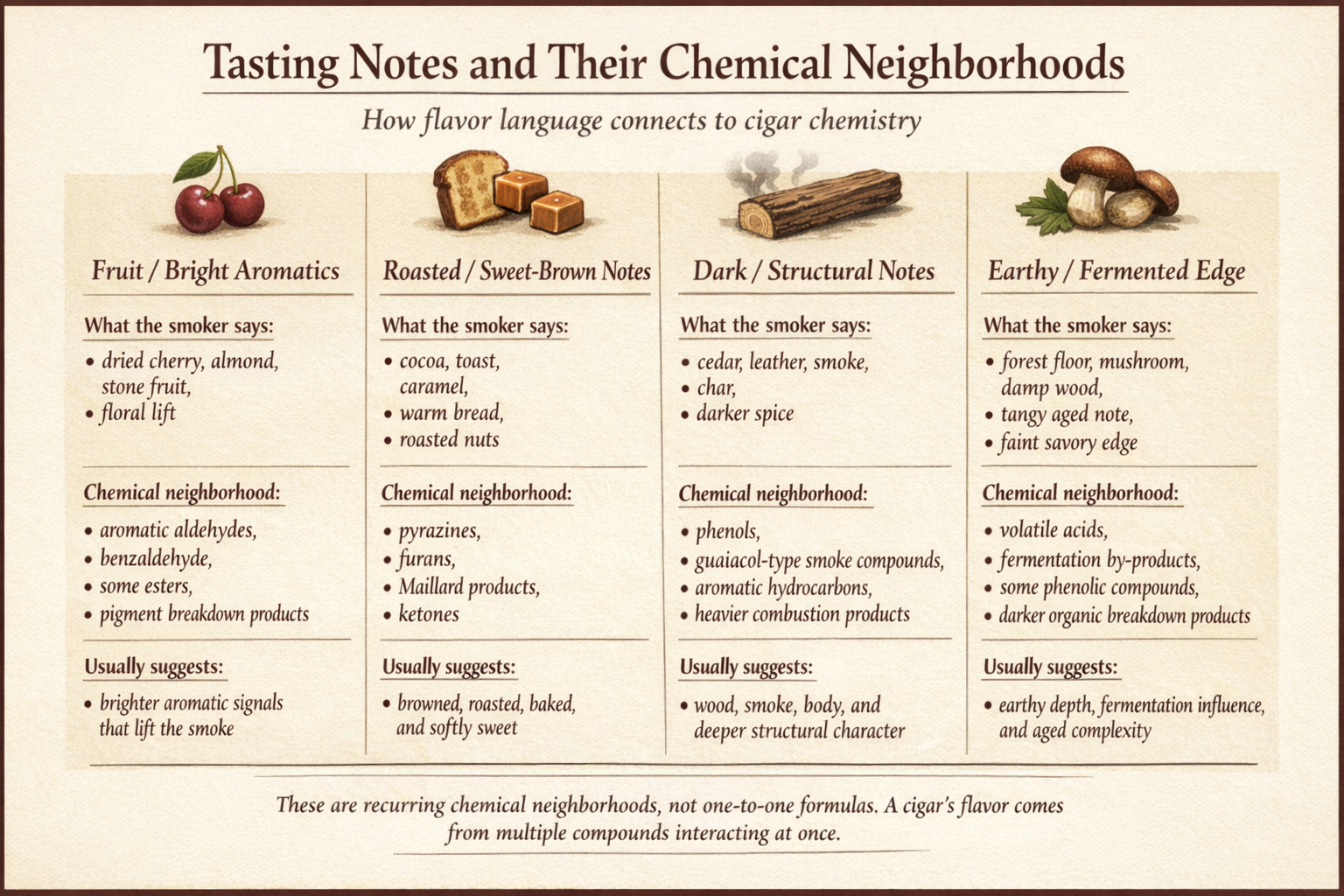
It means the notes people talk about are not floating in the air for no reason. There are actual precursor systems inside the leaf, and they do not all point in the same sensory direction. Some push the profile toward fruit and floral lift. Some toward bread and caramel. Some toward nuts, roast, smoke, and darker spice.
Cherry is not as ridiculous as it sounds
Take cherry.
That note sounds theatrical until chemistry ruins the drama. One of the compounds often brought into this conversation is benzaldehyde, which is associated with bitter almond and cherry-like aromatic impressions. That does not mean the cigar literally contains cherries. It means the smoke can move into the same aromatic neighborhood your brain already knows from cherries, almonds, and stone fruit.
That is the trick behind a lot of tasting notes.
The cigar does not need to contain the food itself. It only needs to produce compounds that hit similar sensory associations.
So when someone says dried cherry, almond, marzipan, or a stone-fruit edge, that is not automatically fake. Sometimes it is simply the least bad human description for a real aromatic signal.
Cocoa, toast, nuts, and warm bread make even more sense
This part is easier to defend.
When sugars and amino compounds react through processing and heat, you start getting the sort of chemistry people already know from browned food. This is where the cigar drifts toward toast, roasted nuts, caramel, cocoa, warm grain, crust, and bread-like depth.
That is why these notes are some of the most believable in cigar tasting.
They are not exotic. They are exactly what you would expect from a fermented organic material that later gets exposed to serious heat.
This is also where leaf position quietly matters. The heavier upper leaves do not simply make a cigar “stronger.” They also carry part of the chemical load that later contributes to darker, denser, more forceful flavor development. Not in a childish one-to-one formula. But enough to matter.
Here the chemistry becomes easier to recognize by name. Pyrazines are strongly tied to roasted and nutty impressions. Furans lean toward caramel-like and toasted character. Other heterocyclic compounds push the profile toward darker roast, cocoa, and baked depth.
So when a cigar gives espresso, toasted almond, cocoa powder, walnut skin, bread crust, or graham cracker territory, that is not the fluffy end of cigar culture.
That is some of the most defensible language a smoker can use.
Earthy is not the same thing as a fermented edge
This is where cigar writing often gets lazy.
People use earthy as if it explains everything dark, old, savory, or strange in a cigar. It does not.
Earthy usually points toward soil, mushroom, forest floor, damp wood, humus, mineral darkness. That is one family of impressions.
A fermented edge is something else. That is the tangier, sharper, more savory side of the experience and sometimes slightly sour, sometimes faintly animalic, sometimes simply aged in a way that feels old rather than merely dark.
In cigar chemistry, that edge is better explained through volatile acids and fermentation by-products than through lazy analogies. Acids such as acetic acid, isovaleric acid, and 3-methylpentanoic acid help make that part of the flavor picture easier to understand.
So if a cigar gives a faint fermented tang, a savory lift, a slightly aged note, or even, in rare cases, something faintly cheesy on the retrohale, that does not automatically mean the cigar is flawed.
It usually means the leaf went through real biochemical change, and some of that story survived into the smoke.
Fire does not just reveal flavor. It changes it
This is the section a lot of cigar writing gets wrong.
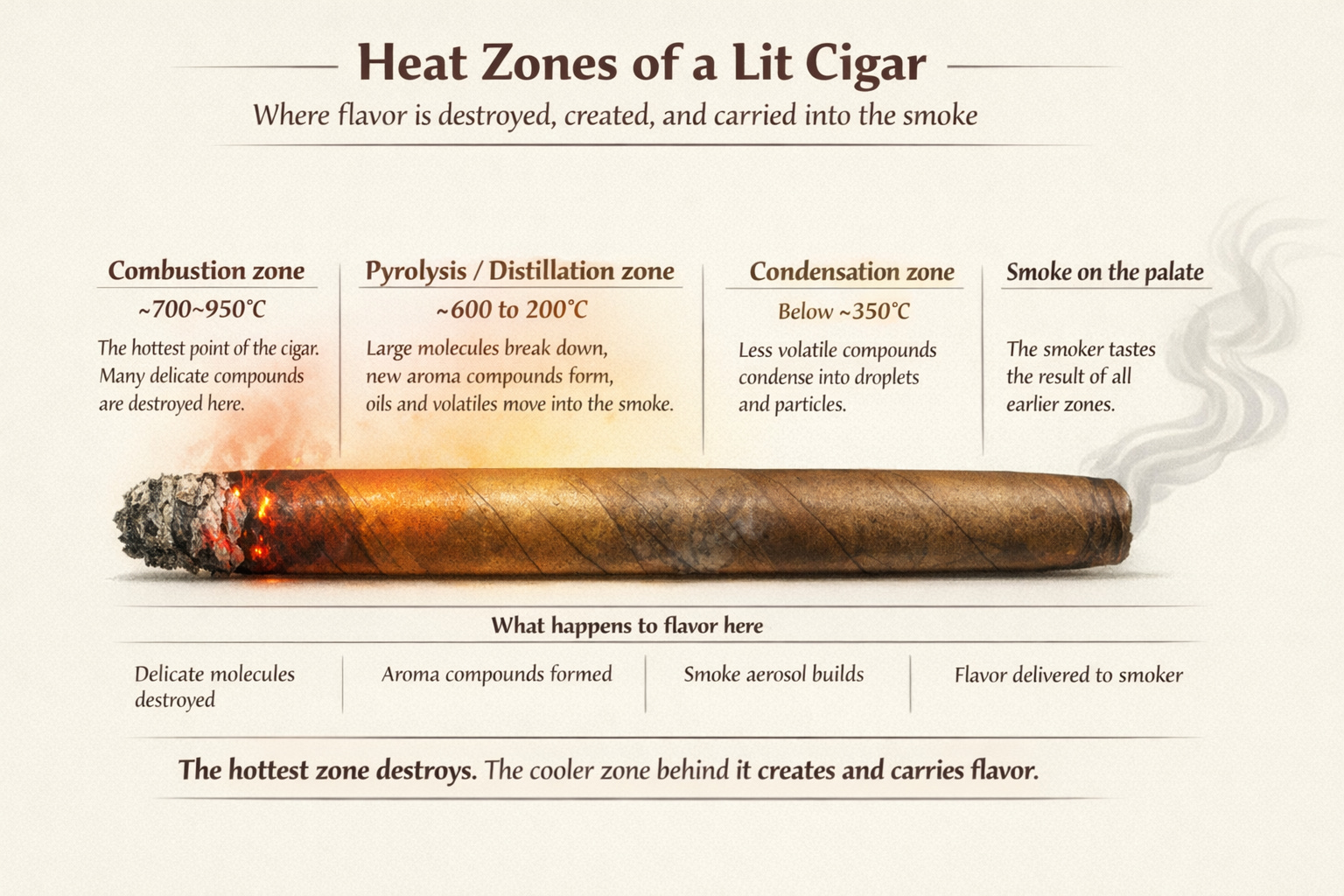
People talk about the lit cigar as if all the flavor comes from the glowing cherry itself. But the hottest part of the burn is violent. During a puff, the coal can reach roughly 800 to 900°C. At that temperature, many compounds are not being preserved. They are being destroyed.
So if you want to understand cigar flavor, you cannot just stare at the cherry. You have to look behind it.
Right behind the burning coal is a cooler region where a lot of the important chemistry actually happens. In that zone, large molecules crack apart, smaller aromatic molecules form, oils vaporize, and compounds are carried forward into the smoke before the hottest part of the burn destroys them. This is where pyrolysis, pyrosynthesis, and distillation-like transfer start mattering.
That distinction is important.
The smoker is not only tasting what the leaf already contained in storage. He is tasting what the leaf becomes under heat.
And that is one reason a cigar changes as it goes. It can open with hay, cedar, dry sweetness, or light toast, then move toward cocoa, darker spice, roasted nuts, leather, earth, and char. The cigar is not static. The chemistry is moving the whole time.
A cigar, in that sense, is not just a rolled leaf.
It is a controlled burn across different temperature zones, different leaf types, and different chemical families — all meeting at once in the smoke.
So are cigar reviewers exaggerating?
Sometimes, yes.
Let’s be fair about this.
Science does not prove that every tasting note in every review is accurate. It definitely does not prove that every smoker has a disciplined palate. Suggestion is real. Vocabulary is messy. Smoking pace matters. Humidity matters. Construction matters. Some people are better tasters than others. Some people are just better at sounding expensive.
But the broad claim that a cigar can honestly suggest cherry, cocoa, fresh bread, roasted nuts, caramel, cedar, earth, flowers, leather, smoke, or a faint fermented edge is not fantasy.
The chemistry gives those notes a real foundation.
At his best, the reviewer is not inventing flavors out of thin air. He is translating a molecular event into human language.
And that is really the whole point.
The next time someone says a cigar tastes like dark chocolate, graham cracker, dried cherry, roasted hazelnut, old cedar, forest floor, or a little aged tang on the retrohale, do not roll your eyes too fast.
The sentence may sound theatrical.
Underneath it, though, there is a very unromantic truth:
leaf chemistry, fermentation biology, blend architecture, and combustion physics are all working together to turn a rolled plant into one of the most chemically expressive things a person can set on fire.
Sources
Carotenoid-Related Volatile Compounds of Tobacco Essential Oils
Microbial and enzymatic changes in cigar tobacco leaves during air-curing and fermentation
Analysis of flue-cured tobacco essential oil by hyphenated analytical techniques