


Read enough cigar reviews and something odd starts to happen. The words keep changing. The experience does not.
One cigar is “smooth with notes of cedar and pepper.” Another is “rich, medium-bodied, with coffee, earth, and spice.” A third is “complex, balanced, creamy, with a long finish.” Different cigar. Different reviewer. Same fog.
Part of the problem is that cigar culture spent years borrowing the prestige language of wine instead of building the language cigar tasting actually needed. It tried to force cigars into somebody else’s frame, as if borrowed elegance could make up for a weak sensory model.
That does not happen because cigars are impossible to describe. It happens because cigar language still leans on a bad habit: asking one vague word “flavor” to carry several very different sensory jobs at once.
One Word, Too Many Jobs
Modern flavor science does not treat the tongue as the whole stage with the rest of the body acting as decoration. Flavor is multisensory. What we casually call “taste” is usually a blend of basic taste, smell, and oral sensation. And in practice, retronasal olfaction -aroma reaching the olfactory region from the back of the mouth during exhalation - does a huge amount of the real identity work.
That matters even more in cigars, which is exactly why so many aficionados place such importance on the retrohale.
Because once smoke enters the picture, the whole thing gets easier to misread. A cigar is not a spoonful of soup.
It is a hot aerosol carrying aromatic compounds, particulate matter, alkaloids, and irritants through a mouth and nose that are trying to do several jobs at once. Some of what reaches you is information. Some of it is interference, or in simpler terms, signals and noise.
And most cigar talk does a poor job separating the two.
Take a familiar line: “It starts woody and sweet, then gets peppery, stronger, and more complex.”
Sounds fine, yet maybe not accurate.
Maybe the aroma signal was reasonably clear at first, then the smoke got hotter, the mouth got drier, the irritating side of the experience got louder, and the cigar became harder to read. What the reviewer called more complex may have been nothing more than a rising wall of bitterness, heat, and dryness. That is not a small difference. It is the difference between tasting a cigar and simply enduring it.
Where the Confusion Begins
What cigar smokers casually call flavor is usually a pile-up of different things: aroma, basic taste, pepper, heat, dryness, body, nicotine pressure, aftertaste, and habit.
That blur feels natural because the brain integrates inputs quickly. But quick integration is not the same thing as clarity. If you confuse aroma with bitterness, or burn with strength, or dryness with sourness, your tasting note may sound vivid while saying almost nothing. Retronasal smell contributes directly to flavor perception, and the route it takes is different from ordinary sniffing from the outside world.
And the confusion is not only sensory. It is psychological too.
In flavor research, context can change how intense something seems, and expectations can shape what people think they are about to experience. That matters here. Smokers often report not just what the cigar delivered, but what they expected, what the cigar represented, what the setting encouraged, or what the moment itself felt like. Prestige, rarity, ritual, mood, and memory can all get mixed into the reading before the cigar is read clearly at all.
Astringency is a perfect example. In cigar language it often gets smuggled into taste vocabulary, as if roughness or dryness were simply another note. But astringency is better understood as a drying, rough, puckering sensation in the mouth, not one of the basic tastes. That matters, because a cigar that feels drier is not necessarily becoming more flavorful. It may simply be becoming more abrasive.
The same goes for pepper.
Many smokers use peppery as if it were proof of seriousness. Sometimes it is treated almost like evidence of quality: if a cigar bites hard enough, it must be full-bodied. But pepper, sting, warmth, throat pressure, and scratch are not doing the same job as cedar, toast, cocoa, flowers, or nuts. One set tells you more about irritation and impact. The other tells you more about aromatic identity. Treating them as the same thing is one reason cigar writing so often sounds louder than it is useful.
The Mouth Is Not a Keyboard
Then there is the old tongue map, one of the great undead ideas in food and tobacco culture. Sweet at the tip. Bitter at the back. Sour on the sides. It survives because it is simple, visual, and wrong.
The classic tongue map has long been discredited. But the correction is not to pretend the whole mouth works identically everywhere. There are small regional differences in sensitivity across the oral cavity. The real point is that the old front-sweet, back-bitter picture was false.
Serious tasting should focus on the mouth as a whole, not just the tongue in isolation. In real flavor perception, taste, texture, temperature, and smoke density interact in the mouth while retronasal aroma does much of the identity work through the nose.
That false map has done real damage because it encouraged a primitive way of thinking: front of the mouth equals sweetness, back equals strength, sides equal sharpness. From there it is only a short step to all the usual lazy reductions, “peppery means full-bodied,” “strong means complex,” “rich means good,” “smooth means refined.”
None of that is a serious sensory method. It is just habit that stayed long enough to look like wisdom.
The nose is the part of the story that exposes this most clearly.
Retronasal odor is not some party trick reserved for smokers who like to sound sophisticated. It is one of the main ways flavor becomes flavor. Research has shown that retronasal and orthonasal smelling differ in route and processing, and retronasal stimulation is tightly tied to flavor perception during eating and drinking.
In plain language, much of what people think they are “tasting” in a cigar is actually aroma being experienced from inside the act of smoking.
Once you understand that, the usual cigar shorthand starts to break apart.
If the nose is doing that much of the identity work, then a tasting note that never distinguishes aroma from irritation is already compromised. If retronasal aroma is central, then brute sensation is not a sign of expertise. And if a cigar carries both aromatic detail and sensory noise at the same time, then the goal of serious tasting cannot be “more effect.” It has to be better separation.
The Loudest Part Is Not Always the Most Revealing
Cigars make that harder than many smokers admit because behavior changes the result. How you puff is not a side issue. In one study of large cigars, smokers used larger puff volumes and higher puff velocity, with shorter intervals between puffs, than they did with cigarettes. That matters here for one simple reason: method changes what reaches you. A cigar does not deliver the same experience regardless of how you handle it.
And this is where the language problem becomes impossible to ignore.
The cigar world has no shortage of adjectives. What it lacks is a stable sensory vocabulary. Too much language is evaluative before it is descriptive. Too much is performative before it is useful.
Too much is built to sound refined rather than to help another smoker understand what actually happened.
A serious tasting language does not have to be sterile. But it should at least try to be descriptive, stable, and useful across people. That is what mature sensory systems do. In fields that take flavor seriously, the goal is not to invent more elegant praise. It is to define attributes more clearly, separate one sensation from another, and make comparison more reliable. The World Coffee Research sensory lexicon is a good example of that logic. It was built to be descriptive, quantifiable, and replicable, not merely expressive.
Cigar culture has often done the opposite. It rewarded flourish over claarity.
That is why one of the most useful habits a serious taster can develop is mistrust, not of pleasure, but of his own first blur. The first thing you feel is not always the thing most worth writing down. The loudest sensation is not always the most meaningful one. And the cigar that seems “stronger” in the second half is not automatically becoming deeper. Sometimes it is simply becoming less readable.
That is worth sitting with, because it changes the aim of tasting.
The aim is not maximum sensation. It is maximum readability because clearer perception usually leads to a better experience and, in the end, more enjoyment.
Not the harshest retrohale. Not the longest list of notes. Not the most luxurious paragraph. Readability. The ability to tell what belongs to aroma, what belongs to basic taste, what belongs to texture, what belongs to burn, and what belongs to the side of smoking that has more to do with irritation than flavor.
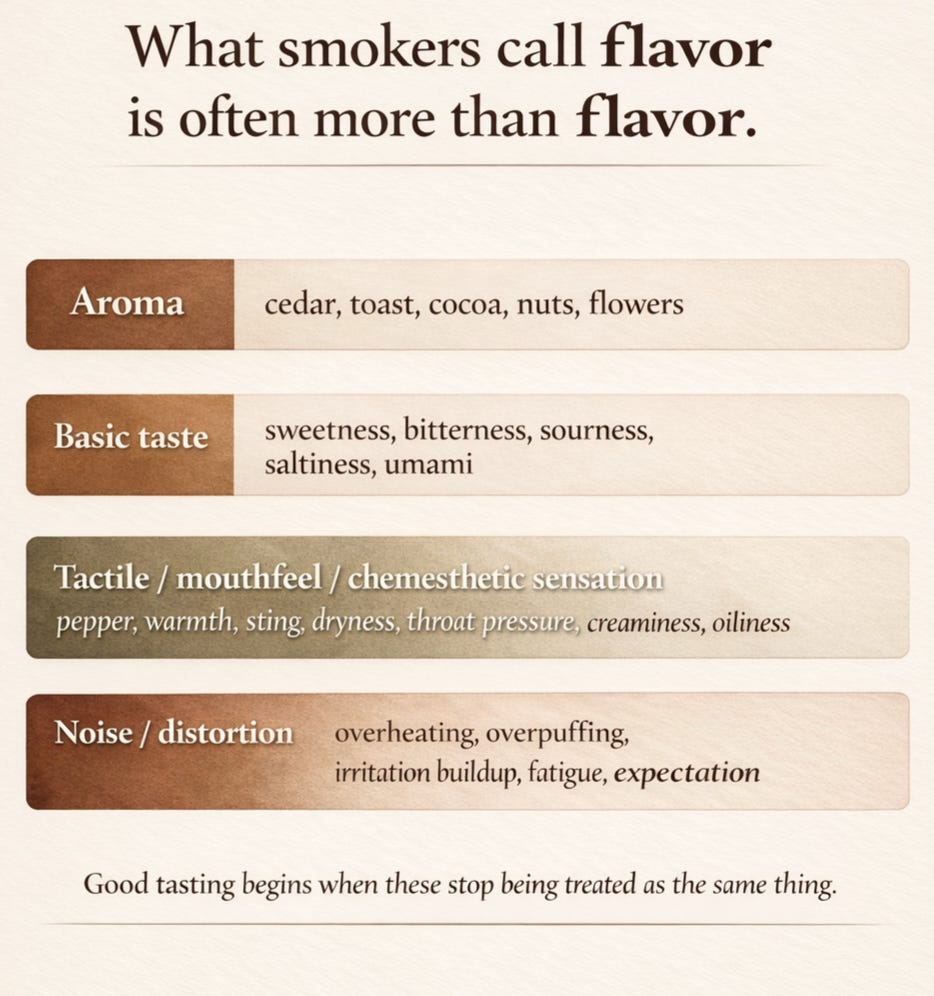
In other words, serious cigar tasting is not about sounding more sophisticated. It is about making fewer category mistakes.
Why This Series Exists
That also means the best taster is probably not the one most eager to imitate famous reviewers. A serious palate is not built by borrowing somebody else’s drama. It is built by learning to notice more honestly, separate sensations more cleanly, and trust distinctions that survive a second pass. That takes method. It also takes humility, because cigar language has been covering up confusion with confidence for a long time.
This is exactly why this series exists.
Not to turn cigars into a laboratory exercise. Not to strip the pleasure out of smoking. And certainly not to bury enjoyment under technical jargon. The point is simpler than that: if cigar flavor is worth talking about seriously, then it is worth perceiving more clearly.
So this first essay is only the ground-clearing move.
Next, we get more precise. We will look at what flavor in a cigar actually is, and why aroma, taste, and chemesthetic sensation need to be kept apart if you want your notes to mean anything. Then we will move into the actual tasting method: puff size, cadence, retronasal handling, heat, and distortion. After that come the neglected parts: the pre-light phase, palate development, note definition, and the way a cigar changes as it burns and as it ages.
That is where the real work starts, and why Cigars in Depth was founded in the first place: to build the system, language, and platform that cigars have long deserved.
Because the problem with most cigar tasting advice is not that it lacks passion. It is that it asks vague language to do the job of sensory discipline.
And that job deserves better.
Sources Behind This Essay
This essay and the whole sensory foundationations series build on research in flavor perception, oral sensation, context effects, smoking behavior, and sensory-language design, along with cigar-specific tasting frameworks.
An informative introduction into the complex and misunderstood world of cigar tasting.