

Sensory Foundations III: Why No Palate Is Neutral
Why serious smokers don't agree, and why the cigar is only half the story

Two connoisseurs could smoke the exact same cigar from the same box, in the exact same environment, at the exact same time, and yet still not have the same cigar experience. One finds cedar and barnyard notes, while the other finds bitterness and notes of coffee.
This is often discussed as if one aficionado has a more refined palate, or as if the issue relates to inconsistency in the blend and/or the brand. It may indeed be partly the case for particular cigars; however, there is another issue here that must be considered. We as individuals do not have the same palate, and that palate is not neutral.
Some might argue that taste is subjective. This is certainly a vague statement, although it serves its purpose in that no one feels uncomfortable, yet not enough clarification is offered to explain why or how.
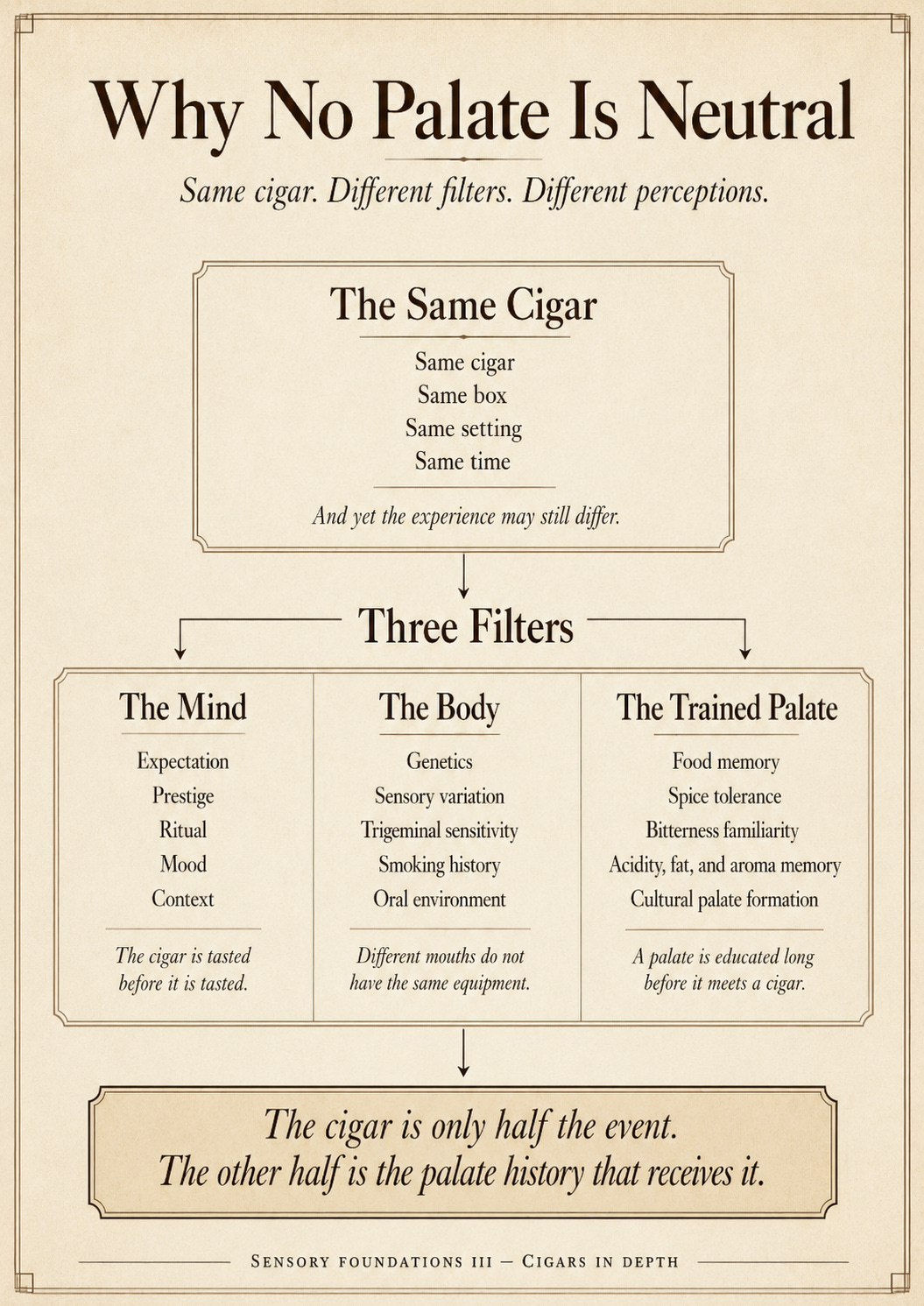
The cigar is not presented in the absence of our senses. It is introduced to a mind that is preconditioned by expectations, to a physiology influenced by genetics and physical processes, and to a palate that has had years and years of training through food and drink.
Research into both wine and flavor experiences has found evidence showing that the context of the experience can affect the experienced pleasantness of flavors, not only in a post-hoc interpretation of events. That context extends to the point that lighting and music can affect the tasting experience.
That is why disagreements continue to persist even among experts, and that is why there is no such thing as a neutral palate.
Tasting the cigar before we even light the cigar
Before taking that first puff, the cigar has already become meaningful in the subconscious mind of the smoker.
Band, price, country of origin, rarity, story , every aspect means something.
Cigars do not exist in a neutral state. There is prestige, ceremony, rarity, hierarchy, social status, and much, much more associated with them. The importance of this is that expectations play a role in our sensory experience.
In sensory science experiments, both price and other environmental stimuli have been shown to change the perceived pleasantness of food consumed. In studies of wine psychology, it has been shown that packaging, lighting, music, and other factors can all contribute to the tasting experience.
Tasting the cigar blind could yield a completely different experience compared to tasting the exact same cigar under the influence of a legendary band. The experience of enjoying the same cigar after a nice dinner and in the company of good friends is going to be completely different from smoking the same cigar when distracted, rushed, and a little irritated. A celebratory moment can make the body more generous, while stress can make you more sensitive to pepper.
Many smokers believe that the cigar calls first, and the brain follows later. The reality is that the brain is part and parcel of the cigar experience from the very start.
A smoker expects a cigar labeled “limited release.” A cigar referred to as vintage, hard to find, unique, or exclusive to a certain area does not appear out of nowhere. It comes loaded with expectations to appreciate it, to overlook its flaws - for even harshness can easily be justified as simply needing rest - and to recognize subtleties where another cigar might simply be considered muted.
This does not make the tasting experience a delusion in any sense. The brain is an integral part of the process.
But this is no small point. This is one of the main characteristics of cigar tasting. Premium cigars are not experienced as mere tobacco smoke; they are experienced through symbolism, desirability, status, and ritual.
Different mouths have different tools
Different mouths come with different sets of sensory receptors and mechanisms.
Some smokers may genuinely perceive bitterness differently from others. Some will be highly sensitive to trigeminal sensations. Some will detect subtle aromas more quickly than others, while others will perceive such aromas more slowly.
Genetic differences may matter significantly when talking about individuals, family groups, ethnic groups, and racial groups. Age also influences this aspect. So does gender. Even smoking history affects it. General studies of the condition of the oral cavity reveal that oral sensory conditions are not universal across individuals.
Taste does not reach the mouth in abstract terms; it reaches it as part of a particular chemical environment. But this does not mean that oral acidity or pH level is the sole criterion of cigar evaluation. However, the effects of the short-term oral environment have been shown to be relevant. Reviews on saliva and its influence on flavor reveal the importance of saliva for in-mouth transport, buffering, and the release of aromas and flavors. Research on oral salivary buffering capacity also shows that the condition of the oral cavity influences the perception of acidic sensations.
Very acidic food or a meal, sweet drinks such as juices, coffee, spicy foods, and the condition of a dry mouth can distort your impressions in the first few minutes of smoking.
Sweetness, dryness, sourness, creaminess, and astringency are not perceived in an absolutely uniform way by the same mouth every time.
Although it enters the mouth each time, the cigar never enters the same mouth.
And this is without even taking culture into account, which I personally view as one of the crucial factors in this case.
The education of the palate occurs long before one meets his first cigar
And now for the part that usually gets omitted in standard cigar discourse. It is important to note that the palate is not taught by cigars. It is taught years beforehand through various foods and beverages.
Through what bitterness, spice, fat, acidity, fermentation, freshness, richness, harmony, cleanliness, maturity, comfort, or excess signify or mean in that particular household. Because all of it is recorded in food memory.
It is unlikely that an aficionado who has been exposed to lots of chili-infused foods will interpret pepper on the palate as an intrusive experience, as opposed to someone whose diet has been milder. It is also likely that a Mediterranean or Levantine smoker will have fewer issues with bitterness, herbs, acidity, the intensity of olive oil, citrus, or complex aromatic freshness. On the other hand, a smoker accustomed to frequent coffee drinking and comfort foods, creamy, sweet, and grain-based dishes is more likely to identify vanilla-coffee-caramel structure right away.
One only needs to think about Indian, Italian, American, Middle Eastern, North African, and Gulf-region aficionados with different culinary backgrounds shaping their palates.
What we get is a more realistic approach. Culinary habit trains the mouth to recognize which forms of contrast and satisfaction feel right.
Therefore, the wider and richer your culinary experiences become, the richer your food memories may become, and the greater the number of possible sensations derived from cigars.
Smokers do not walk into a cigar experience with no history behind them. Their senses have had years of preparation through spiciness, bitterness, fats and oils, acidity and sourness, aromatics, pain tolerance, and reward mechanisms.
In this context, the idea of a neutral palate is utterly unrealistic and fails to account for all the years of preparation that precede the acquisition of cigar vocabulary and language.
Once one accounts for expectation, biology, and sensory training, many apparently familiar arguments about cigars can actually be resolved with greater clarity.
One is not always speaking poorly, or merely differently, when characterizing an object that another smoker also perceives. Rather, one may be receiving an entirely different balance of stimuli. The cigar, after all, is not being evaluated according to itself alone; it is being evaluated with respect to the smoker’s background.
Why Some Cigars Travel Better than Others
All of this becomes even more interesting once one begins thinking beyond the isolated individual and into the marketplace.
It goes without saying that some cigars travel better in some markets than in others. There is nothing offensive about that. Neither is there anything particularly controversial in the matter. That is how business operates. Habanos, for example, recently reported that Europe represented 54 percent of the company’s total sales value in 2024. Habanos’ top five sales markets were China, Spain, Switzerland, the United Kingdom, and Germany. And cigar producers continue to release region-specific products rather than presume that all markets want the same thing from their cigars.
But the reason goes beyond commerce. One can also say that flavor architectures encounter different levels of sensory friction depending, in part, on their relationship to local culinary tradition, culture, ritual, and expectation. This would explain the involvement of distributors in the blend tasting of the ER, the Edición Regional.
Let us turn now to some exploration questions.
Could the success of Cohiba cigars and special Cuban releases in China be related as much to status as to taste?
Could the stronger preference for Padrón cigars in America relative to Europe relate not only to branding and availability but also to differences in palate formation and culinary experience? While Fuente cigars are successful in Europe, usually the milder ones, could this have something to do with Dominican tobacco somehow resembling Cuban flavor notes — something European palates are used to?
Could it be that some Cuban brands have better availability in Europe, for example El Rey del Mundo, Sancho Panza, and Saint Luis Rey, because of demand shaped partly by palate?
Why are there so many Regional Editions that hail from Phoenicia, and from Ramón Allones in particular? Could that have something to do with the stronger and more flavorful profile of this brand and how it might suit a Middle Eastern palate formed by full-flavored cuisine?
Are the special releases that Joya de Nicaragua, Oliva, and Liga Privada have launched for Europe and in Germany, especially, an indication of something here?
On the other hand, globalization introduces an additional layer of complication. The availability of a number of cuisines from all over the world within a single country implies exposure to different culinary traditions, including French, Japanese, Chinese, American, Mediterranean, and Middle Eastern cuisine.
People’s palates become more open to trying different cigar blends. Several years ago, I had acquaintances in the Arab world who smoked exclusively Cuban cigars. At present, many of them have added New World cigars to their collections as well. Even though this tendency became visible prior to the scarcity and price hikes in Cuban cigars, those pressures definitely contributed to it. People started to try and taste different cigars, and some of them eventually shifted toward New World tobacco.
What the expert’s palate does and does not change
From here, one might think that everything turns out to be purely subjective. But this is not quite the case.
Professional experience allows for improved consistency and clarity. An experienced smoker can distinguish between aroma and sensation, perceive structure, and avoid succumbing to superficial cues.
However, professional experience does not produce neutrality. It produces awareness.
Awareness of personal bias, expectations, physiological peculiarities, and contextual influences. Awareness of how perception is formed long before the cigar is lit.
Subjectivity cannot be eliminated; however, it can be disciplined.
A cigar reaches the palate through sensory organs, expectations, aromatics, chemesthesis, past experience, saliva, memory, cuisine, repetition, ritualism, symbolism, and language. The cigar is the trigger, while the palate’s experience makes up the second half.
It is still possible to exercise serious judgment, but not before acknowledging this complexity.
The real expert is not neutral. He knows that neutrality was impossible all along.
Resources
Plassmann H, O’Doherty J, Shiv B, Rangel A. Marketing actions can modulate neural representations of experienced pleasantness.
Spence C. Wine and Psychology: Basic and Applied Issues.
Baines D, et al. Chili pepper preference development and its impact on dietary intake: A narrative review.
Francis Canon, Fabrice Neiers, Elisabeth Guichard. Saliva and Flavor Perception: Perspectives
Great effort, a long but very fun article, a deep study to analyze the character of the cigar and the character of the smoker of this cigar. Thanks a lot Mr. Amr
Interesting to note that subjectivity still remains at all levels of smoking. It is that subjectivity that makes conversations with other aficionados that much more enjoyable. Great article sir